
Beginner guide
Your First Pull-Up: A Zero-to-One Plan for Beginners
Can't do a single pull-up? A week-by-week beginner plan: dead hangs, scapular pulls, rows, negatives and assisted reps, plus how long it really takes.
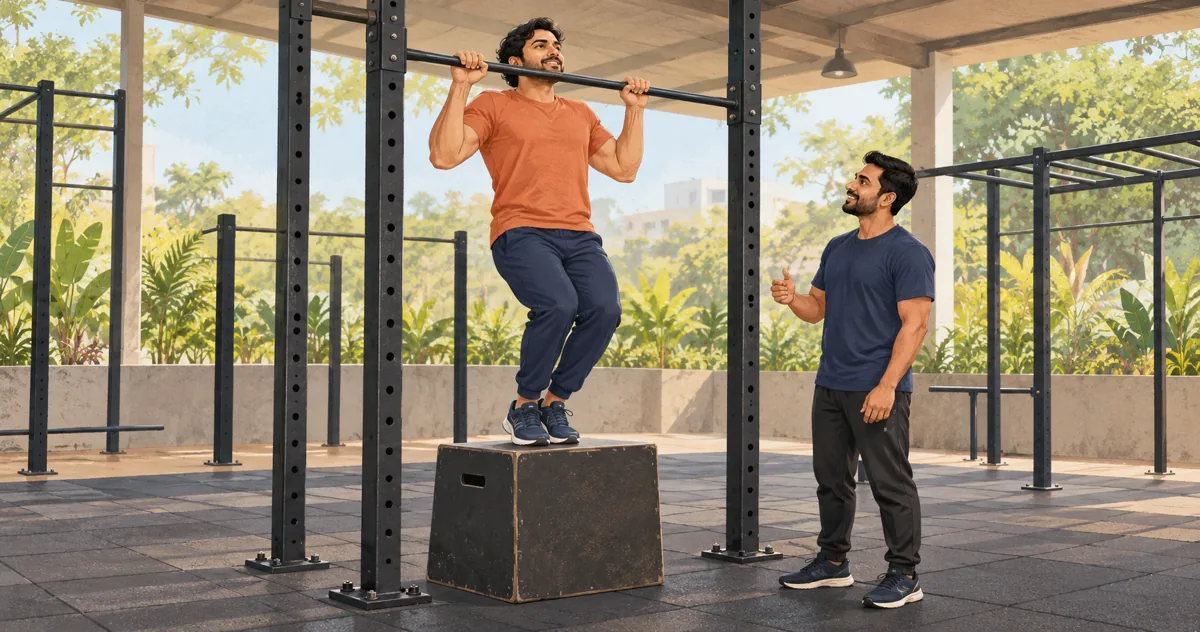
Short answer: Most beginners can get their first pull-up in roughly 6–12 weeks by training 3 times a week with dead hangs, scapular pulls, rows, slow negatives and assisted pull-ups. Starting from very low strength or higher body weight, it can take a few months longer, and that is normal. You don't need to lose weight first; you need a step-by-step progression and enough rest between sessions.
Why a pull-up feels impossible at first
A pull-up asks your back (lats), arms, grip and core to lift your whole body weight. Most adults never train that pattern, so even people who are strong in the gym or at work often can't do one. It is a skill as much as a strength test. The good news: each piece (grip, shoulder blades, the pulling muscles, control on the way down) can be trained separately and then put together.
Who this plan is for
- Adults and teens who can't yet do one full pull-up, including complete beginners and people returning after a break.
- Heavier beginners: the plan works for you too. Assisted and inclined versions let you train at your level from day one.
- Kids: children can hang, swing and climb, and that builds the base. At K2 kids train in coached kids batches with age-appropriate progressions, not a strict adult plan like this one. See kids calisthenics classes.
- Check with a doctor first if you have a shoulder, elbow or back injury, or a heart condition.
Before you start: test yourself
Do these on day one and write the numbers down. Retest every 2 weeks.
1. Dead hang: hang from the bar with straight arms. How many seconds?
2. Scapular pull: in a hang, can you pull your shoulders down and away from your ears without bending your arms?
3. Negative: jump or step up so your chin is over the bar. How many seconds can you take to lower yourself?
If you can hang for 30+ seconds and lower yourself slowly for 5+ seconds, you can start at Weeks 3–4.
The zero-to-one plan, week by week
Train 3 days a week with at least one rest day between sessions (for example Mon/Wed/Fri). Warm up for 5–10 minutes first: arm circles, band or light shoulder movements, and a few easy rows. Rest 60–90 seconds between sets. Stop each set with 1–2 good reps still in the tank.
Weeks 1–2: Hang and set your shoulders
- Dead hang: 3 sets of 10–20 seconds. Feet can touch a box if needed.
- Scapular pulls: 3 sets of 5–8 slow reps. Arms straight, shoulders pull down, pause 1 second.
- Inclined (Australian) rows on a low bar: 3 sets of 6–10. Body straight, chest to the bar.
- Hollow body hold: 3 sets of 15–20 seconds for core control.
Weeks 3–4: Build the pulling muscles
- Dead hang: 3 sets of 20–30 seconds.
- Scapular pulls: 3 sets of 8–10.
- Rows: 3 sets of 8–12; walk your feet forward to make them harder.
- Flexed-arm hang: jump to the top (chin over bar) and hold 3 sets of 5–10 seconds.
- Negatives: 3 sets of 2–3 reps, lowering for 3–5 seconds each.
Weeks 5–6: Slow negatives and assisted reps
- Negatives: 3–4 sets of 3 reps, lowering for 5–8 seconds. Control the whole way to straight arms.
- Assisted pull-ups: 3 sets of 4–6 with a resistance band, a partner holding your feet, or your feet on a box taking some weight. Use the least help that still gives clean reps.
- Rows: 3 sets of 8–12 at a harder angle.
- Dead hang: 2 sets of 30–45 seconds.
Weeks 7–8 and beyond: Less help, then try one
- Assisted pull-ups: 3–4 sets of 3–5 with a lighter band or less foot help.
- Negatives: 3 sets of 3, lowering for 8–10 seconds.
- Test day (once a week, fresh, after a warm-up): try one full pull-up from a dead hang to chin over bar.
- Not there yet? Keep repeating Weeks 5–8 and keep reducing assistance. Progress often comes in a jump after a few weeks that felt flat.
How long does it really take?
These are typical ranges from general coaching guidance, not guarantees:
- Already active, lighter body weight: often 4–8 weeks.
- Complete beginner: often 2–3 months.
- Very low starting strength or higher body weight: 3–6 months or more.
Consistency matters more than speed. Three steady sessions a week for two months beats two hard weeks and a month off.
Common mistakes that slow you down
- Only trying full pull-ups. Failing the same rep every day doesn't build strength. Train the steps.
- Dropping fast on negatives. If you can't control the way down, do shorter, slower reps.
- Half reps. Start each rep with straight arms and finish with your chin over the bar.
- Shrugged shoulders. Keep shoulders away from your ears; this is what scapular pulls teach.
- Kicking and swinging. Keep legs together and the body tight.
- Training every day. Pulling muscles and elbows need recovery. 3 sessions a week is enough.
- Ignoring grip. If your hands give out first, add more dead hangs.
Safety notes
- Warm up every time and stop if you feel sharp pain in your shoulder, elbow or wrist. Mild muscle soreness for a day or two is normal; joint pain is not.
- Use a stable bar and a box or step to get up and down. Don't jump down from height.
- Increase only one thing at a time: more seconds, more reps or less assistance.
- Sleep, water and enough protein help recovery.
How K2 coaches your first pull-up
At K2 Calisthenics Park in Bharthana, Vesu (near Ofira), Surat, coaches guide every session and every batch has a beginner group, so you can start at your level in any batch. Coaches watch your form, choose the right step for you and adjust as you get stronger. For focused one-on-one work on pull-ups and other skills, see personal training.
- Timings: Monday to Saturday, 6–10 AM and 5–10 PM. Closed on Sundays.
- Training area: open on all four sides under a 20 ft roof, so you can train through sun and rain.
- What to bring: a water bottle, a towel and a mat. Have some dry fruits and a fruit 45–60 minutes before training.
- Resistance bands: K2 has resistance bands for assisted pull-ups, so you can train the full progression in class.
New to calisthenics? Read how to start calisthenics without a push-up and our beginner calisthenics guide, or browse all programs.
Contact us on WhatsApp +91 90999 95559 or call +91 90999 95559.
How long does it take to do your first pull-up?
Most beginners get their first pull-up in about 6–12 weeks of training 3 times a week. People starting with very low strength or higher body weight may need 3–6 months. These are typical ranges, not guarantees.
Should I lose weight before training pull-ups?
No. Start now with assisted and inclined versions. Losing extra weight makes a pull-up easier, but strength training and fat loss can happen together.
Chin-up or pull-up first?
Chin-ups (palms facing you) are usually a little easier because your biceps help more. It's fine to get a chin-up first and keep training pull-ups (palms facing away) alongside.
Why can't I do a pull-up even though I'm strong?
A pull-up needs back, grip and shoulder control relative to your own body weight. Strength from other lifts doesn't always carry over, so train the pull-up steps directly.
Are negative pull-ups good for beginners?
Yes. Lowering yourself slowly from the top builds strength you can't yet use on the way up. Aim for 3–8 seconds per rep and keep the reps controlled.
How many days a week should I train pull-ups?
Three days a week with a rest day between sessions is enough for most beginners. Pulling every day can strain the elbows and slow progress.
What are the benefits of dead hangs?
Dead hangs build grip strength, get your shoulders used to hanging and help you hold the bar long enough to train pull-ups. Start with 10–20 seconds and build up.
Can I train for my first pull-up at K2 Calisthenics Park?
Yes. Every batch at K2 has a beginner group, and coaches guide your progression. Batches run Monday to Saturday, 6–10 AM and 5–10 PM. Book a free 2-day trial or WhatsApp/call +91 90999 95559.
Explore our coached calisthenics classes in Surat.